Onopordum acanthium, widely recognized as cotton thistle, is a formidable biennial plant that can attain heights of up to 3 meters (nearly 10 feet) in its second year. Characterized by spiny, deeply lobed leaves and globe-shaped flowers in shades of dark pink to lavender, it produces an astounding 8,400 to 40,000 seeds per flowering cycle. Thriving in full sunlight and dry soils, this resilient species is native to Europe and Asia but poses a significant invasive threat in North America, where it disrupts local ecosystems. Its complex role as a pollinator attractant hints at deeper ecological implications worth exploring further.
Main Points
- Onopordum acanthium, commonly known as cotton thistle, is a biennial plant that can reach heights of up to 3 meters.
- It produces spiny, deeply lobed leaves and globe-shaped flowers that range in color from dark pink to lavender.
- Considered an invasive species in North America, it threatens local ecosystems and biodiversity.
- Cotton thistle thrives in dry, disturbed habitats, requiring full sun and good drainage in USDA zones 4 to 8.
- The plant attracts pollinators like bees and butterflies, playing a complex ecological role despite its invasive nature.
Introduction
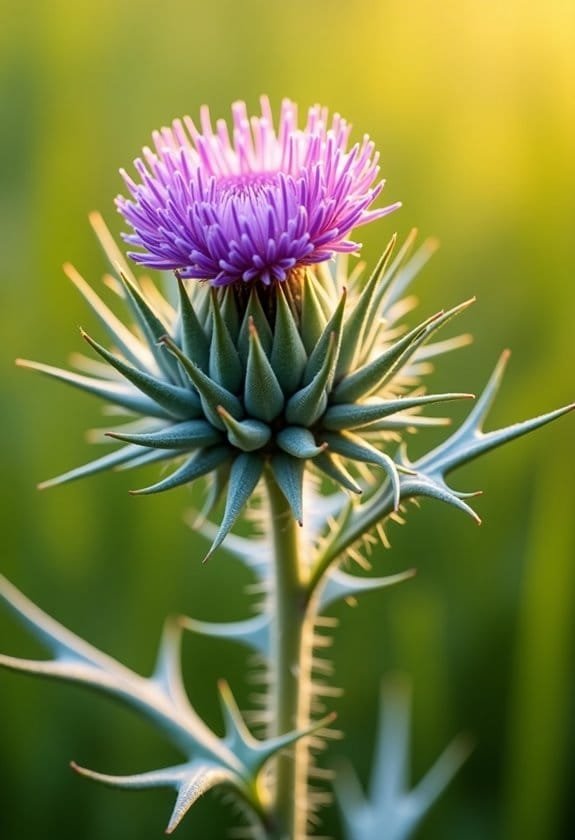
Commonly known as cotton thistle, Onopordum acanthium presents a striking appearance with its towering height and spiny foliage.
This biennial plant, which can reach up to 3 meters (9.8 feet) in its second year, is notable for its ability to produce an astonishing number of seeds, enhancing its potential for invasive behavior.
Native to Europe and Asia, its adaptation to dry, disturbed habitats has led to ecological concerns, especially in regions like North America, where it competes aggressively with native species.
Common Name
The cotton thistle, also known as Scots thistle or woolly thistle, can often lead to confusion due to its resemblance to Cirsium vulgare, Scotland's national emblem. This misidentification illustrates the complexities inherent in common naming conventions within botanical circles.
Onopordum acanthium, the scientific name for this perennial plant, features distinctive spiny leaves and globe-shaped flowers that range from dark pink to lavender, enhancing its identification.
Native to Europe and Asia, this thistle has made its way to North America, where it often becomes invasive, threatening local ecosystems by out-competing native flora.
Standing up to 3 meters tall, the cotton thistle can produce an astonishing number of seeds—between 8,400 to 40,000 post-flowering, a fact that amplifies its spread across disparate landscapes.
The genus name, "Onopordum," has an intriguing origin, derived from Ancient Greek, meaning "donkey fart thorny food," an amusing yet vivid descriptor that reflects its spiny texture.
Understanding the common names and characteristics of Onopordum acanthium is essential for both conservation efforts and the promotion of native biodiversity.
Scientific Name
Onopordum acanthium, a striking member of the Asteraceae family, showcases the fascinating interplay between common names and scientific classification. Known colloquially as cotton thistle, this biennial plant captivates with its formidable spiny leaves and towering heights, reaching up to 3 meters (9.8 feet) during its second year.
The genus name "Onopordum," intriguingly derived from Ancient Greek, translates to "donkey fart thorny food," highlighting its historical connection to both forage and its robust, albeit prickly, nature.
Characterized by a large rosette of leaves in its first year, Onopordum acanthium is prolific in reproduction, producing an astonishing range of 8,400 to 40,000 seeds that can endure in soil for an impressive 7 to 20 years. This genetic resilience underpins its adaptability across various environments.
Moreover, three accepted subspecies exist—Onopordum acanthium subsp. acanthium, subsp. gautieri, and subsp. parnassicum—each offering unique traits and ecological roles. Together, these aspects underline the significance of Onopordum acanthium not just in its appearance, but also in its ecological impact and adaptation strategies.
Overview
Cotton thistle, known scientifically as Onopordum acanthium, stands out in various landscapes with its tall, spiny structure and striking flower heads. This biennial plant can reach heights of up to 3 meters, showcasing large, spiny leaves in its first year.
Native to Europe and Asia, cotton thistle thrives in dry, disturbed habitats like roadsides and fields, but it has become invasive in North America, expanding across millions of hectares.
One of its remarkable features is its prolific seed production; each plant can generate between 8,400 and 40,000 seeds, which remain viable in the soil for 7 to 20 years. Seeds mainly germinate in autumn following rainfall, further enhancing its capacity to dominate local ecosystems.
The cotton thistle produces globe-shaped flowers that range in color from dark pink to lavender, attracting various pollinators. In addition, its leaves serve as food for certain caterpillar species of Lepidoptera.
While appreciated for its ornamental properties and potential medicinal benefits, Onopordum acanthium's aggressive growth can outcompete native flora, leading to significant ecological repercussions in new environments.
Understanding cotton thistle's characteristics is vital for managing its spread and safeguarding biodiversity.
Key Features
Onopordum acanthium, or cotton thistle, impressively towers at heights of up to 3 meters during its second year, showcasing a prominent rosette of spiny leaves in its first.
The plant's striking appearance, with alternate and hairy foliage spreading 10 to 50 cm wide, highlights its distinctive presence in any landscape.
Blooms of dark pink to lavender flowers, globe-shaped and measuring 2 to 6 cm in diameter, further enhance its remarkable aesthetic, marking its flowering season as a fascinating spectacle.
Growth Size
This remarkable biennial plant can reach impressive dimensions, growing up to 3 meters (9.8 feet) tall and 1.5 meters (4 feet 11 inches) wide in its second year.
In its initial growth phase, Onopordum acanthium forms a distinctive rosette of spiny leaves, establishing a robust foundation for its later expansive growth. These leaves can measure between 10 to 50 centimeters (3.9 to 19.7 inches) in width and are characterized by their spiny, hairy texture, which enhances both its visual impact and defensive mechanisms against herbivores.
Once the plant evolves into its flowering stage, it produces globe-shaped flower heads that range from 2 to 6 centimeters (0.79 to 2.36 inches) in diameter, showcasing shades from dark pink to lavender.
This vibrant display not only attracts pollinators but also contributes to its ecological significance, as a single Onopordum acanthium can yield between 8,400 to 40,000 seeds.
Such prolific seed production guarantees the thistle's survival and adaptation in various environments, making it a fascinating example of resilience and reproductive success in the plant kingdom.
Appearance
The striking appearance of Onopordum acanthium captures attention with its towering height and impressive dimensions. This remarkable cotton thistle can grow up to 3 meters (9.8 feet) tall and span 1.5 meters (4 feet 11 inches) wide by its second year, making it an unmistakable presence in any landscape.
Its large, alternate leaves, characterized by their spiny and hairy texture, measure between 10 to 50 cm (3.9 to 19.7 inches) wide, contributing to the plant's formidable aesthetic.
Adding to its allure, the entire cotton thistle is enveloped in a velvety white bloom that enhances its distinctive look. These rich textures create a contrast with the plant's flowers, which are globular and range in color from dark pink to lavender, measuring 2 to 6 cm (0.79 to 2.36 inches) in diameter.
Each cotton thistle has an impressive reproductive capacity, producing anywhere from 8,400 to 40,000 seeds post-flowering, ensuring its presence for years to come. Collectively, these features portray Onopordum acanthium not just as a plant but as a striking natural sculpture, embodying resilience and beauty.
Flowering Season
During the flowering season, which typically spans from July to September, Onopordum acanthium showcases its impressive display of large, globe-shaped flower heads. These striking blooms, characteristic of Scotch thistle, vary in color from deep pink to delicate lavender, creating a vibrant tapestry that beckons a multitude of pollinators. Each flower head measures between 2 to 6 cm in diameter and is often supported by broad, flat receptacles, accentuating the plant's distinctive allure.
The flowering can occur with solitary blooms or in clusters of up to five, further enhancing their visual impact against the backdrop of meadows and disturbed areas.
After flowering concludes, each plant can produce an astonishing 8,400 to 40,000 seeds, ensuring a robust reproduction cycle that secures its presence in the ecosystem for seasons to come.
As these seeds disperse, they contribute to the resilience of Onopordum acanthium, allowing it to thrive in various environments. The combination of attractive flowers and prolific seed production underscores the significance of Scotch thistle not just as a visually striking plant, but also as an essential player in its habitat.
Growing Requirements
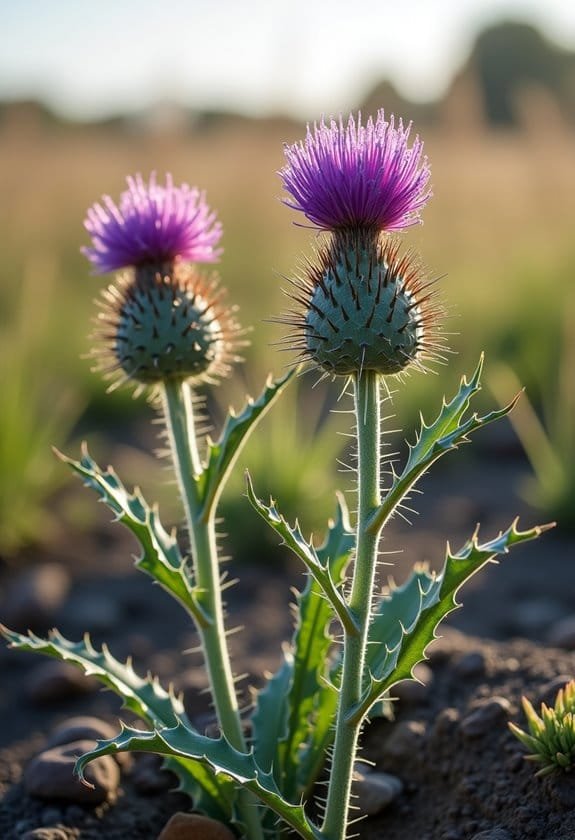
Onopordum acanthium thrives best under full sun exposure, as this robust plant can reach remarkable heights of up to 3 meters in its second year.
It prefers dry, sandy clay or calcareous soils that brim with ammonium salts, providing the ideal foundation for its growth.
Understanding its water and temperature needs is crucial for successful cultivation, as these factors intricately influence the plant's life cycle and overall health.
Light
Requiring abundant sunlight for ideal growth, Onopordum acanthium flourishes in full sun exposure, demanding at least 8 hours of light each day. This robust biennial plant thrives in environments where sunlight penetrates freely, establishing itself rapidly in disturbed habitats.
The germination process of cotton thistle seeds is particularly influenced by light availability; alternating light and dark cycles create ideal conditions for sprouting. Conversely, when grown in shaded or low-light conditions, its growth and flowering potential may be severely hindered, resulting in stunted development and reduced flowering yields.
Proper light conditions are essential for Onopordum acanthium's biennial lifecycle, which comprises two distinct phases. In the first year, the plant develops a rosette stage that requires ample light to store energy for future growth.
In the following year, when flowering occurs, the accumulated energy promotes vigorous blossoms that attract pollinators. Consequently, cotton thistle showcases a remarkable dependence on light; without sufficient exposure, it can't shift smoothly between its growth stages, jeopardizing its lifecycle.
Adequate light not only enhances its survival but also guarantees it can dominate the landscape and contribute to the local ecosystem.
Soil
Soil quality plays an essential role in the successful growth of Onopordum acanthium, with the plant thriving in sandy clay and calcareous soils rich in ammonium salts. Native to Europe, this resilient species flourishes in dry summer habitats found in disturbed sites like roadsides, fields, and agricultural areas.
It requires ideal soil conditions that facilitate good drainage, as overly saturated environments can inhibit growth.
For seed germination, soils should provide abundant light exposure, allowing for the essential alternating light and dark cycles. Ideally, about eight hours of light per day will yield the best results in sprouting the seeds.
Soil must be well-aerated and allow moisture to drain effectively, as these conditions mimic the plant's Mediterranean origins where moisture levels are lower.
Additionally, the remarkable longevity of Onopordum acanthium seeds, which can remain viable for seven to twenty years in soil, underscores the importance of managing soil conditions.
By preventing unwanted germination and spread, gardeners can maintain a balance in their ecosystems while appreciating the unique characteristics of this striking thistle.
Proper soil management is vital in supporting the plant's growth and maintaining its place in the Mediterranean flora.
Water
The water needs of Onopordum acanthium are vital for its growth and development, particularly during its first year. This biennial plant flourishes in dry summer habitats, primarily relying on rainfall for germination. Ideal conditions typically arise after autumn rains, allowing the seeds to sprout when moisture is present. During its initial establishment phase, moderate watering is essential, as it helps the plant form a large rosette of spiny leaves that, in turn, aids in water conservation during its second year.
While established Onopordum acanthium exhibits notable drought resistance, prolonged dry spells can impede growth greatly. This trait makes it an invasive species in various regions, as it can thrive in environments with minimal water competition. Moreover, incorporating plants like Germander Speedwell in the landscape can enhance moisture retention and provide diverse ecological benefits.
Nonetheless, providing adequate moisture during early growth stages enhances the plant's overall establishment and development, positioning it for success in disturbed or dry landscapes. Sustainable management of its water supply not only supports the Cotton Thistle's growth but also addresses the challenges posed by its invasive spread, as robust plant health can mitigate its dominance in native ecosystems.
Temperature
Onopordum acanthium thrives in warm climates that reflect its Mediterranean origins, making temperature an essential factor for its growth. This biennial thistle species adapts well within USDA hardiness zones 4 to 8, showcasing resilience against varying seasonal temperature extremes.
While it can withstand cooler conditions during its initial growth phase, best flourishing occurs when temperatures remain warm, particularly during its significant flowering period from July to September.
In these ideal conditions, the thistle develops a vast rosette of leaves in its first year, enabling it to capitalize on available resources and endure less favorable temperatures. As it shifts to its second year, Onopordum acanthium can achieve impressive heights of up to 3 meters (9.8 feet), a demonstration of its robust growth potential when nurtured in a temperature environment conducive to its Mediterranean heritage.
Therefore, gardeners aiming to cultivate this remarkable thistle species should maintain a warm, frost-free climate during its blooming period, enhancing growth and promoting the overall health of the plant.
With the right temperature balance, Onopordum acanthium can flourish, transforming gardens into vibrant displays of this majestic thistle.
Pollinator Criteria
Onopordum acanthium draws an impressive array of pollinators, particularly bees and butterflies, with its abundant nectar and large, globe-shaped flowers.
These vibrant blooms flourish from July to September, aligning perfectly with the heightened activity of various pollinator species during this critical time.
The plant's unique characteristics not only enhance local ecosystems but also provide essential resources for wildlife, thereby emphasizing its crucial role in supporting biodiversity. Additionally, similar to Rough Hawkbit, its presence can indicate ecological health, serving as a sign of well-preserved habitats.
Attracted Pollinators
Many different pollinators are drawn to Onopordum acanthium due to its nectar-rich flowers and vibrant globe-shaped heads. Measuring 2 to 6 cm in diameter, these alluring flower clusters, which range in color from dark pink to lavender, captivate the attention of bees and butterflies.
The flowering period, spanning from July to September, coincides with a time when many other plants have already ceased blooming, offering essential sustenance for pollinators in late summer. Crataegus monogyna, also known as common hawthorn, is another flowering plant that supports pollinators during this time.
As the national emblem of Scotland, Onopordum acanthium plays a key role in supporting local ecosystems. Its thick, spiny foliage not only provides shelter and protection for various pollinators but also serves as a habitat for several caterpillar species of Lepidoptera.
Each flowering plant can produce an impressive quantity of seeds—roughly 8,400 to 40,000—which attract birds like goldfinches, further integrating the plant into its ecological community. Additionally, the presence of plants like Guelder Rose (Viburnum Opulus) in the ecosystem enhances overall biodiversity and attracts more pollinators.
Ultimately, the interdependence of Onopordum acanthium and its pollinators illustrates the delicate balance within nature, showcasing how a single species can considerably enhance local biodiversity.
Pollination Method
The pollination method of Onopordum acanthium relies heavily on a select group of pollinators, primarily bees and butterflies, that are drawn to its nectar-rich, globe-shaped flowers.
These distinct flowers consist of numerous individual florets, which offer ample landing surfaces for visiting insects, facilitating the intricate process of pollination. Typically, flowering occurs from July to September, a time that coincides with the peak activity of many essential pollinator species.
The synchronization of flowering with pollinator activity is imperative; studies have shown that this alignment considerably influences seed set and overall plant fitness. As bees and butterflies visit the thistle, they inadvertently transfer pollen from one flower to another, promoting genetic diversity and enhancing reproductive success.
Following pollination, Onopordum acanthium produces seeds designed for wind and animal dispersal, which helps establish new plants in previously pollinated areas.
This effective pollination method ultimately guarantees the species' survival within its ecosystem, showcasing the intricate relationships among plants and their pollinators.
Without these indispensable interactions, the delicate balance of ecological systems would be disrupted, underscoring the importance of conserving pollinator populations.
Care & Maintenance
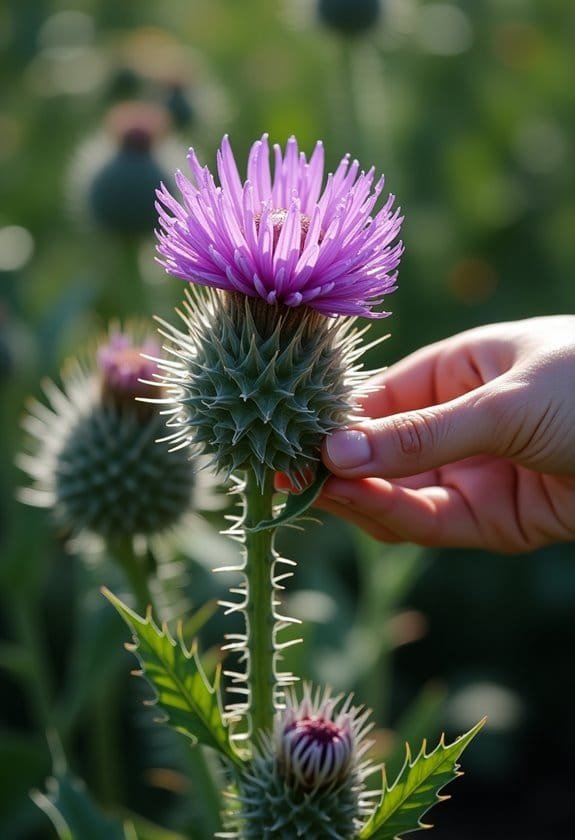
Caring for Onopordum acanthium involves understanding its specific needs for ideal growth and maintenance.
This biennial plant flourishes in full sun and demonstrates resilience in dry, well-drained soils, making it a perfect candidate for low-maintenance gardens.
Employing thoughtful planting techniques and considering companion plants won't only enhance its aesthetic appeal but also guarantee a balanced ecosystem within the garden. Additionally, this plant thrives in disturbed areas, allowing it to establish itself easily in various environments.
Planting Tips
Although Onopordum acanthium thrives in full sun and dry, average conditions, successful planting hinges on providing ample space for its expansive growth.
This biennial plant can reach impressive heights of up to 3 meters (9.8 feet) in its second year, forming a large rosette of spiny leaves during its initial growth phase. As a result, gardeners should guarantee sufficient spacing between plantings to accommodate this robust growth.
When planting, it's crucial to take into account light conditions, as ideal germination occurs with alternating light/dark cycles, ideally with around 8 hours of light exposure.
Additionally, Onopordum acanthium produces a staggering quantity of seeds—ranging from approximately 8,400 to 40,000 after flowering. These seeds can create a significant seed bank in the surrounding soil, germinating after autumn rains and potentially leading to uncontrolled spread if not monitored carefully.
To control this tendency, proactive measures, such as incorporating competitive perennial grasses, can suppress thistle growth while preventing recolonization.
Moreover, similar to blackberry management, implementing integrated management strategies can help mitigate Onopordum acanthium's invasive potential and promote ecological balance in the landscape.
Taking these planting tips into account guarantees a healthier environment for Onopordum acanthium, allowing for its majestic development while maintaining ecological balance.
Ongoing Care
Ongoing care for Onopordum acanthium requires regular attention to its growing conditions. Beginning in early spring, the plant thrives in well-drained sandy clay or calcareous soils, calling for careful preparation of the planting area.
While cotton thistle demonstrates adaptability to various light conditions, it flourishes under full sun, which is essential for seed germination and subsequent growth.
Maintaining moderate watering practices is important; allowing the soil to dry out between waterings engenders robustness, as the plant is more tolerant of dry conditions once established.
Regular monitoring for seed production is fundamental—each plant can yield between 8,400 and 40,000 seeds, necessitating vigilance to prevent unwanted invasiveness in the landscape.
Although fertilization is generally unnecessary, as Onopordum acanthium naturally thrives in nutrient-poor soils, incorporating organic mulch around the base can retain soil moisture and suppress competitive weed growth.
Suggested Companions
When incorporating Onopordum acanthium into a garden, selecting the right companion plants can make a significant difference in managing its growth and enhancing the overall design. To mitigate its invasive tendencies, gardeners should consider pairing this striking biennial thistle with competitive perennial grasses. These resilient plants can help suppress the emergence of impenetrable stands, allowing for a more balanced ecosystem.
Ensuring adequate sunlight is essential, as cotton thistle thrives in full sun conditions. Companion plants with similar light preferences can help maintain a harmonious planting environment.
In the garden's first year, short-lived or annual species provide visual interest while Onopordum acanthium establishes itself. The vibrant blooms of these annuals also support pollinators, which are naturally attracted to the thistle.
Incorporating flowering companions that bloom at different times enhances overall biodiversity, ensuring continuous support for pollinator populations.
Regular maintenance, including vigilant monitoring for self-seeding and invasive spread, is fundamental for maintaining a balanced and healthy garden with Onopordum acanthium and its carefully chosen companions.
Common Issues
As Onopordum acanthium proliferates across landscapes, it faces various challenges, including pests and diseases that can threaten its invasive dominance.
While resilient, this thistle isn't immune to specific infestations and ailments, which can affect its growth and spread, presenting valuable opportunities for management.
Understanding these issues and developing effective solutions will be essential in mitigating its impact on ecosystems and agriculture.
Pests/Diseases
Pests and diseases can pose significant challenges for Onopordum acanthium, commonly known as cotton thistle. Although this plant exhibits a degree of resistance to many pest and disease pressures, it's not immune to threats such as root rot and fungal infections, particularly in poorly drained soils.
The cotton thistle's spiny leaves serve as a natural deterrent against some herbivores, yet they don't protect against specific caterpillars from the Lepidoptera order, which may find a meal in its foliage.
Moreover, cotton thistle can host various pests, such as aphids and beetles. These pests weaken the plant and compromise its overall vigor, making it more susceptible to disease.
The plant's prolific seed production contributes to its vulnerability, resulting in dense stands that impede the movement of natural predators, disrupting the local ecosystem's balance.
Regular monitoring and management practices are imperative to mitigate the risk of pest accumulation, which could subsequently lead to disease development. By attending to these common issues, one can help maintain healthier cotton thistle populations, ensuring their growth continues without substantial interference from pests. Additionally, adopting measures to control Hounds Tongue may further protect native ecosystems from invasive threats that can affect cotton thistle and other local flora.
Solutions
Implementing effective solutions for managing Onopordum acanthium guarantees healthier populations and mitigates the impacts of common issues. Chemical control methods, particularly at the rosette stage, show the highest effectiveness.
Herbicides like Picloram and 2,4-D, applied during early spring or autumn, can considerably reduce thistle populations. However, the challenge lies in the plant's seeds, which remain viable in the soil for 7 to 20 years, necessitating long-term management strategies.
Integrated Pest Management (IPM) approaches promote the combination of herbicides with the sowing of competitive grasses. This method suppresses thistle growth while preventing its re-emergence, fostering a robust ecosystem that can withstand invasive species.
Additionally, while biological control options have been studied, no specific agents for cotton thistle have been released in the U.S., indicating a pressing need for ongoing research.
Vigilance in monitoring disturbed habitats remains vital, as Onopordum acanthium outcompetes native flora, particularly in pasture lands, therefore threatening local ecosystems.
Summary

Onopordum acanthium, known as cotton thistle or Scots thistle, is a striking biennial plant that can tower up to 3 meters (9.8 feet) tall during its second year. This species showcases deeply lobed, spiny leaves and globe-shaped flowers that shift from dark pink to lavender.
While its beauty is remarkable, this plant poses significant challenges as an invasive species in North America, prominently covering over 22,540 hectares in Utah by 1989.
Adaptable and opportunistic, cotton thistle thrives in disturbed environments like roadsides and agricultural areas, which provide the regeneration gaps it requires for ideal growth. Each flower head can yield an astounding 8,400 to 40,000 seeds, exacerbating its invasive nature.
Despite its disruptive tendencies, Onopordum acanthium offers valuable ecological benefits, including nectar for pollinators and seeds for birds. These contributions underscore the complex balance between its role in ecosystems and the threat it poses to native flora. This plant's aggressive growth pattern necessitates careful management to prevent its spread and protect local biodiversity.